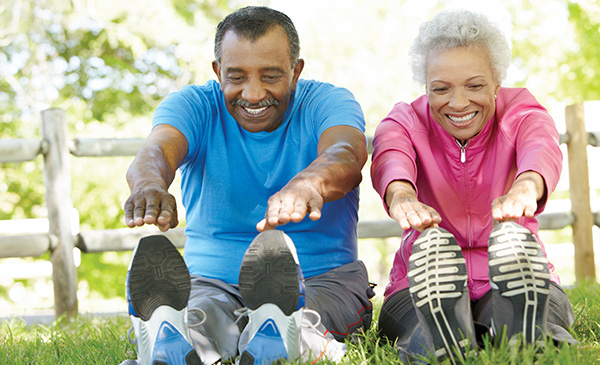
Osteoarthritis – and its aching joint pain – often keep people from doing one of the best things proven to make them feel better: exercise.
Studies show that staying physically active helps reduce osteoarthritis pain, improves function, and positively affects a person’s quality of life. Regular exercise also helps people sleep better, maintain a healthy body weight, and keep an upbeat attitude.
Roughly 27 million people over the age of 25 have osteoarthritis – a degenerative joint disease. Osteoarthritis mostly affects cartilage. The surface layer of cartilage breaks and wears away, allowing bones to rub together. Pain, swelling, and loss of motion of the joint result. Over time, the joint may lose its normal shape and small deposits of bone – bone spurs – may grow. Sometimes bits of bone or cartilage can break off and float inside the joint space.
Although osteoarthritis becomes more common with age, younger people can develop it, too. Osteoarthritis is also more likely to occur in people who are overweight or who are in jobs that stress particular joints.
Exercising also helps people with osteoarthritis manage other chronic conditions that are common among adults: diabetes, heart disease, and obesity.
Osteoarthritis Pain Relief
Four forms of exercise for people with osteoarthritis include:
Flexibility – Get flexible with Yoga and Tai Chi, exercises that help alleviate stiffness and keep the body’s joints moving.
Strengthening – Weightlifting and other weight-bearing exercises can help you keep and build your muscles. Small hand weights can help build upper and lower arm strength. Squats and lunges strengthen the lower body while planks work the entire core.
Aerobic and Endurance – Swimming and biking are both excellent forms of aerobic and endurance exercises, which can help reduce swelling in some joints. Endurance exercise is also good for the heart and arteries.
Balance and Agility – Ask your physical therapist which specific balance and agility exercises are right for you.
Always check with your physical therapist or physician before starting any exercise program. Some types of activity may need to be avoided, especially when joints are swollen or inflamed.
Source: National Institutes of Health, Centers for Disease Control and Prevention
Learn about exercise, nutrition counseling and diabetes management by visiting Bon Secours Physical Therapy www.bonsecoursphysicaltherapy.com
February is Heart Month! We encourage you to take steps this month to get heart healthy by participating in our Heart Check Challenge. Click HERE to take the FREE HeartAware Risk Assessment or visit us at rvaheart.com and Twitter #HeartCheckRVA
Valentine ’s Day doesn’t have to be the waistline downfall it is typically made out to be. If you thought sweet treats couldn’t be healthy, think again. Here are just a few ways to be sweet and good to eat.…
Rice Crispy Treats: use brown puffed rice or another whole grain cereal instead of regular. Sub the melted butter for your nut butter of choice (like peanut butter or almond butter) and top with pink and white sprinkles. They can be made in to tons of shapes too from traditional bars, to balls, to hearts, or “X”s and “O”s.
By Abby Forman, Registered Dietitian with Bon Secours In Motion Physical Therapy & Sports Performance
We all know stress is bad, but do you know just how bad it can be for your heart? When you are stressed, your body makes more of certain hormones that raise your blood pressure and heart rate and can lead to an increase in your risk for heart attack and stroke. Even worse, what do you do when you are stressed? You eat more, and are more likely to eat out–often fast, high-fat and unhealthy foods (when was the last time you were so stressed you reached for the carrots?). You sleep less, which further increases your body’s production of those harmful stress hormones. We are also much less likely to exercise and are more likely to drink alcohol, smoke cigarettes, and down more caffeine. You may even forget to make your medicines, leading to even higher blood pressure and uncontrolled blood sugar.
All of these unhealthy behaviors, combined with the stress itself, wreak havoc on your health. In severe cases, stress has been shown to cause a “heart attack” in people without any other risk factors for heart disease. This is called the “broken heart syndrome” or Takotsubo’s cardiomyopathy: the arteries of the heart spasm, stopping blood flow to the heart muscle and causing heart injury and even heart failure.
We all know life is stressful, so what can we do about it?
Start by carving 30 minutes out of your day to exercise. Taking a walk, dancing to your favorite tunes, or going for a bike ride can help you de-stress immediately, lowering your blood pressure and bringing down your anxiety levels. Don’t over-schedule: you can only be in one place at one time, so review your to-do list and say “no” sometimes. Take a 5-minute relaxation break when you feel stressed: even deep breathing and guided imagery at your desk can help you relax and recharge. Go to bed a little earlier. Studies have consistently shown that people who sleep more than 7 hours a night live longer.
February is Heart Month, so join Bon Secours and start living a heart-healthy lifestyle today. For more information on how to take control of your health or to support the health of the people you love, visit www.bonsecours.com
The majority of people who follow restrictive diets, those that put strict rules on what or how much you can and can’t eat, regain the weight within five years. Almost two-thirds regain more weight than they initially lost. This says something very powerful about “dieting”: it works in the short term (maybe), but does not get to the root of our weight gain. Those who adopt small changes for a healthier eating lifestyle, have greater success in the long run. How can we do that? One of the first steps to making lifelong changes, is awareness of what your current eating behaviors are and why. Practicing mindfulness with our food includes being aware of internal hunger and fullness cues, not using food for stress relief, choosing enjoyable and wholesome foods, thinking through food choices instead of relying on impulse, and nonjudgmentally accepting food preferences. Research has shown that increasing mindfulness can not only help with weight loss, but also decrease overall stress, impact body image, and affect food preferences. Are you a mindful eater? Try this introductory mindful eating exercise, “Raisin Consciousness,” developed by expert Dr. Kabat-Zinn and colleagues.
Raisin Consciousness (source: University of Minnesota)
Sit comfortably in a chair.
Place a raisin in your hand.
Examine the raisin as if you had never seen it before.
Imagine it as its “plump self” growing on the vine surrounded by nature.
As you look at the raisin, become conscious of what you see: the shape, texture, color, size. Is it hard or soft?
Bring the raisin to your nose and smell it.
Are you anticipating eating the raisin? Is it difficult not to just pop it in your mouth?
How does the raisin feel? How small it is in your hand?
Place the raisin in your mouth. Become aware of what your tongue is doing.
Bite ever so lightly into the raisin. Feel its squishiness.
Chew three times and then stop.
Describe the flavor of the raisin. What is the texture?
As you complete chewing, swallow the raisin.
Sit quietly, breathing, aware of what you are sensing.
By Abby Forman, Registered Dietitian with Bon Secours In Motion Physical Therapy & Sports Performance