Especially after the holidays, when cooking more food than people can eat seems to be just as traditional as the foods we make, food safety for leftovers has to be on the brain. So how long can that ham or turkey be kept? The answer: seven days if it is stored at a maximum of 41oF (5oC). If you end up using that turkey in a casserole or soup, it still has a maximum of seven safe days. This means that if you cook the bird on a Monday and make it into a stew on Thursday, it has until Sunday to be eaten safely if continuously stored in the fridge. Those foods you know you won’t eat in time should be frozen as soon as possible. Try freezing leftovers in individual portions or individual meal containers. This way you only thaw and cook the amount you will eat next time. Follow these safety rules and your leftovers will last even longer than the month of holidays.
By Abby Forman, Registered Dietitian with Bon Secours Physical Therapy & Sports Performance
As the number of new hepatitis C virus infections keeps rising, federal health authorities are urging people at risk to get tested.
Nearly half of people living with the virus don’t know they’re infected. Many people don’t have any symptoms. Left untreated, people can develop liver cirrhosis, which can cause liver cancer. They can also spread the virus to other people and their children.
A simple blood test can tell whether someone has hepatitis C. Treatment calls for taking anti-viral drugs for 8 to 12 weeks.
“The treatment is incredibly effective,” said Mitchell Shiffman, MD, medical director of Bon Secours Liver Institute. “The cure rate is 97 to 99 percent.”
The rising number of hepatitis C infections is primarily a result of increasing injection drug use associated with America’s growing opioid epidemic, according to the federal Centers for Disease Control and Prevention. Over five years, the number of new infections has nearly tripled, reaching a 15-year high. The highest number of new infections is among 20- to 29-year-olds.
“If you’re a young adult who’s used IV drugs, you absolutely should be tested,” Shiffman said.
Still, most of the 3.5 million Americans living with hepatitis C are baby boomers born from 1945 to 1965. Baby boomers are six times more likely to be infected with hepatitis C than any other age group. They also face greater health risks because they’ve had the virus since the 1960s or 1970s.
Chronic hepatitis C infection is the leading reason people need liver transplants in the United States.
While most people are asymptomatic, others might feel overly tired because, as the virus inflames the liver, it uses up energy. Liver cirrhosis increases fatigue and can cause internal bleeding and confusion.
If you have liver cirrhosis, the clock is ticking. Eventually, it can lead to liver cancer.
“Many people who have cirrhosis and liver cancer are not aware they have had chronic HCV for decades,” Shiffman said. “If they had found out they had hepatitis C even five years ago, they could have been treated and cured and may not have cirrhosis or liver cancer today.”
CDC officials recommend Hepatitis C testing for the following groups of people:
People born from 1945 through 1965.
Anyone who has ever injected illegal drugs, including those who injected only once many years ago.
Recipients of clotting factor concentrates made before 1987.
People who had blood transfusions or solid organ transplants before July 1992.
Anyone who has ever received long-term hemodialysis treatment.
Anyone infected with HIV.
Patients who have signs or symptoms of liver disease such as abnormal liver enzymes.
Children born to mothers who have tested positive for hepatitis C.
For more information or to find a healthcare provider near you, call 804-359-WELL or visit http://goodhelpdocs.com/.
by Mark Dixon, MD, Fellowship-Trained Breast Imager
Christian Shield, MS, MD/MHA, Fellowship-Trained Breast Imager
Directors of Breast Imaging, Bon Secours Richmond Health System, Commonwealth Radiology Associates
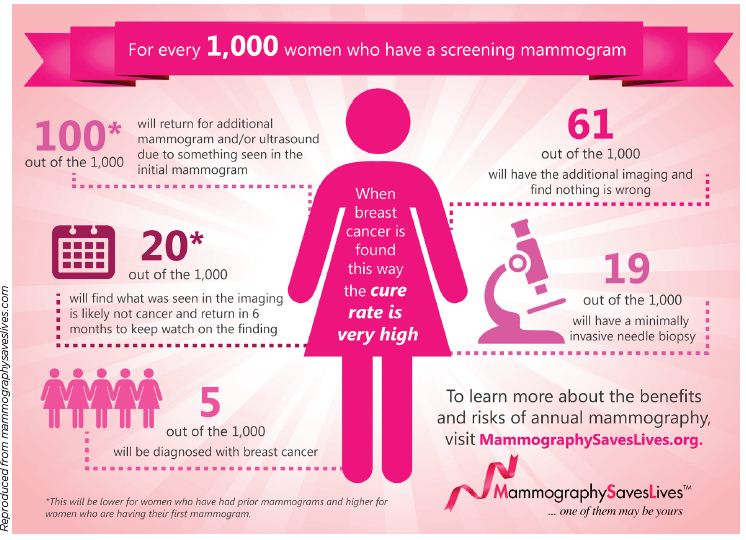
Annual screening mammography—beginning at age 40 and continuing yearly—delivers the greatest benefit to the most women.
Thankfully, there has been dramatic progress in the treatment of breast cancer over the past several decades. In fact, the mortality from breast cancer since 1975 has decreased approximately 35%. A woman’s lifetime risk of breast cancer is approximately 12%—one in eight. As one might expect, this risk varies by age. Approximately 20% of breast cancer is diagnosed in women 40–50 years of age.
Recently, controversy has been generated about when to begin screening mammograms. Some would argue that screening should start after 45–50 years of age and be performed less frequently. The interdisciplinary breast specialists at Bon Secours believe in optimizing the benefits of screening for breast cancer. Waiting until 50 years of age to begin mammography would miss the opportunity to diagnosis and treat 20% of breast cancer. Screening more frequently than 24 months reduces mortality. Therefore, we continue to support yearly screening mammograms starting at age 40. We are not unique in our viewpoint. The American College of Radiology and Society of Breast Imaging continue to recommend screening at 40 years of age, as do leading cancer centers across the country, such as Memorial Sloan Kettering and MD Anderson.
The justification for the changes in screening mammography guidelines is not based on any scientific evidence. In fact, studies continue to show the benefits of screening mammography. The justifications for later and less frequent screening were based upon “efficiency” and over emphasized “harm” of screening and “overdiagnosis.”
Efficiency is simply the desire to minimize cost and maximize return on investment; it does not seek to maximize benefit. This is an economic decision that strives to minimize the cost to the system without consideration of the benefits to the individual.
Screening “harm” is the anxiety created when a woman is asked to return for additional images. In fact, only about 10% of women are asked to return, and the majority of these women are given reassurance that nothing is wrong. We feel the perceived “harm” from anxiety is overstated as compared to the very real harm of not detecting cancer. Additionally, cancers detected at a later stage may result in the need for more aggressive and extensive treatments, which can carry real consequences.
“Overdiagnosis” is simply the concept that some pre-invasive cancers, so-called Ductal Carcinoma in Situ or DCIS, may never evolve to be life-threatening. Unfortunately, we do not yet have the knowledge to predict which DCIS will harm the patient and which will not, so all DCIS is treated the same. We should always seek a cancer diagnosis where possible. Hopefully, in time, we will learn which cancers require treatment and which can be followed with surveillance.
We have dedicated our lives to detecting and fighting breast cancer. We feel passionately about women’s breast health and trust we have given you a good understanding of why you should begin getting yearly mammograms at age 40. Simply said: mammograms save lives. Start at 40!
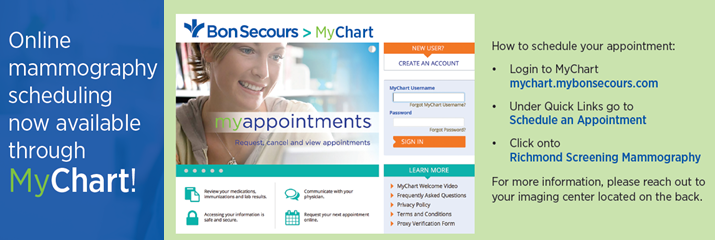
Call 804‑627‑5660 to schedule your mammography appointment today!
Or, as part of your MyChart experience, you are now able to schedule your mammography appointment online at mychart.mybonsecours.com.
When flu season hits, immune function hits the brain. Most people think of Vitamin C for flu or cold prevention, but why? The answer is “ROS.” Reactive oxygen species, ROS, are the byproducts of natural metabolism of oxygen in the body. The formation of ROS, while normal, can be increased by exposure to pollution, UV radiation, certain foods, and even exercise. When produced in overabundance, ROS can cause damage to the cells leading to compromised immunity, inflammation, and disease. Antioxidants are essentially ROS neutralizers, giving the ROS something else to react with so that they do not harm other cells. Vitamin C is one of the most commonly known antioxidants, but others that can be found in the diet include Vitamin E, Vitamin A, and polyphenols. The easiest places to spot antioxidants are in the colors of your whole fruits and vegetables. Get a variety of colors to maximize different nutrients and immune boosting antioxidants. Your body will thank you.
By Abby Forman, Registered Dietitian with Bon Secours Physical Therapy & Sports Performance
Prostate cancer affects one out of seven men. Although it can be a serious disease, most men who have been diagnosed with prostate cancer do not die from it.
Fortunately, prostate cancer can often be detected with a simple blood test. The test measures the level of prostate-specific antigen in a blood sample. The blood level of PSA is often elevated in men with prostate cancer, according to the National Cancer Institute. However, other non-cancerous conditions can also cause a man’s PSA level to rise. The only way to know if the test is abnormal because of cancer is to do a biopsy.
For years, prostate cancer screening was a routine part of annual checkups for men over the age of 50. Today, it’s uncertain if the benefits of testing outweigh the risks. The best way to decide if you need to be screened is to talk it over with your health care provider.
“Your family history, your age, your ethnicity, and whether you have any symptoms all play a role in the decision-making process for screening,” said Dr. Nelson Sarino, a family medicine physician at Town Center Medical Associates in Virginia Beach. “It’s a decision based on each person’s individual risk factors.”
Prostate Cancer Risk Factors
Research shows that a man’s risk for prostate cancer increases as he gets older. Having a family history of prostate cancer may also raise your risk. A man with a father, brother, or son who has had prostate cancer is two to three times more likely to develop the disease, according to the federal Centers for Disease Control and Prevention.
Prostate cancer is also more common in African-American men. Medical experts do not know why, but African-American men often get prostate cancer at a younger age than others. The cancer also grows faster.
Prostate Cancer Symptoms
Symptoms of prostate cancer can vary among men. Some men have no symptoms at all.
Some symptoms of prostate cancer include:
Difficulty starting urination.
A weak or interrupted flow of urine.
Frequent urination.
Difficulty emptying the bladder completely.
Pain or burning during urination.
Blood in the urine or semen.
Pain in the back, hips, or pelvis.
Painful ejaculation.
If you’re worried about any symptom you’re having, be sure to talk to your doctor about it.
Many men who are diagnosed with prostate cancer do not need to be treated for it. Unlike other types of cancer, some prostate cancers are so small and grow so slowly, they do not need treatment. Instead, it’s best to have “active surveillance,” which is where the cancer is monitored but not treated. Most men over the age of 65 who have prostate cancer do not die from the disease.
With many false-positive results from screening, figuring out whether you need to be screened underscores the importance of having a primary care physician who sees you on a regular basis.
“Talk to your doctor, especially if you have a family history of prostate cancer or have any questions about the screening,” Dr. Sarino said. “Your decision to be screened should be based on your own individual risk factors.”
For more information or to find a healthcare provider near you, call 804-359-WELL or visit http://goodhelpdocs.com/.